2.9% jobless rate hides 10.1% youth unemployment as AI cuts entry jobs
National unemployment reads 2.9%, but DOSM data shows 10.1% of 15-to-24-year-olds jobless while AI erodes the routine tasks that once trained newcomers.
What happened1/6 The 2.9% figure does not tell a fresh grad's story
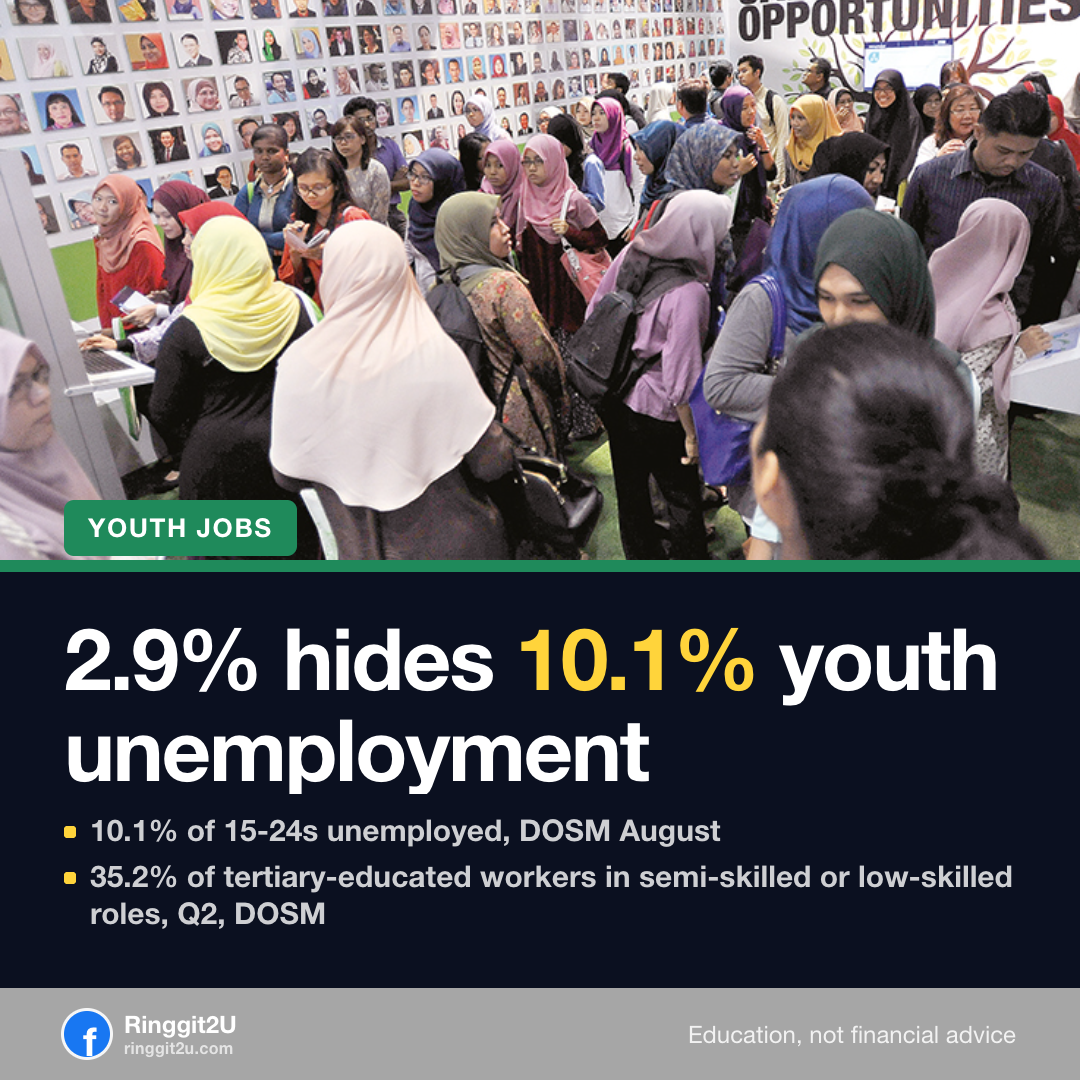
The national jobless rate sits at 2.9 per cent, but the Department of Statistics Malaysia (DOSM) put unemployment among 15-to-24-year-olds at 10.1 per cent in August, or 291,300 people.
Andy Iskandar Baharudin, 23, a finance graduate from a public university, has applied to more than 100 companies since his internship ended in July. Marketing graduate Nafeesa Azman, 24, has sent 200 to 300 applications in two months.
The routine tasks that once trained newcomers — taking notes, preparing slides, compiling data — are now done faster and cheaper by AI, the South China Morning Post noted.
The real numbers2/6 The gap between the headline rate and the graduate reality
10.1%youth unemployment (15–24), August291,300young Malaysians without work32.2%graduates underemployed in 2024DOSM found that 35.2 per cent of employed tertiary-educated workers were in semi-skilled or low-skilled roles in the second quarter. The Human Resource Ministry told Parliament in June that 1.6 million graduates, or 32.2 per cent of the graduate workforce, were underemployed in 2024.
Indicator Figure Source / period National jobless rate 2.9% DOSM, 2026 Youth unemployment (15–24) 10.1% / 291,300 DOSM, August 2026 Tertiary grads in low-skilled roles 35.2% DOSM, Q2 2026 Graduates underemployed 1.6 million (32.2%) HR Ministry, June 2026 - 01/03
The gap between the headline rate and the graduate reality ✓youth unemployment (15–24), August 10.1% youth unemployment (15–24), August
Why it matters3/6 AI thins the first rung, but large-scale losses are not confirmed
A study commissioned by the Human Resources Ministry found last year that 600,000 existing jobs were 'at risk' from AI. However, then minister Steven Sim said up to 60 per cent of employers across 10 key sectors expected AI to create jobs.
The International Labour Organization estimates nearly 80 million South-east Asian workers will be affected by AI, and 11.7 million could lose jobs or see tasks reworked. Its July report, however, found no evidence yet of large-scale AI-driven job losses in the region.
The picture is mixed: AI is removing the low-complexity tasks that used to be a graduate's first assignment, but the total job count has not collapsed. The bottleneck is the entry point, not the whole ladder.
How it affects your wallet4/6 RM3,000 is the ask; RM2,500 is the proposed floor for grads
Nafeesa wants at least RM3,000 a month, but says employers armed with AI tools are lowballing on pay. Many offers fall short of that figure.
Budget 2027 proposes a starting wage of RM2,500 a month for semi-skilled positions and graduates. This is not the national minimum wage, which is RM2,000 from June 2027. The implementation details for the RM2,500 starting wage have not been released.
e.g. A fresh grad offered RM2,500 gross, after EPF (11%), SOCSO and EIS deductions, takes home roughly RM2,200 before PCB. At that salary, PCB is normally RM0 for a single employee with only automatic reliefs.
- 02/03
291,300 young Malaysians without work The gap between the headline rate and the graduate reality young Malaysians without work
Why it matters5/6 Singapore moves on the same broken bottom rung
Singapore Prime Minister Lawrence Wong said on 12 October that AI may have already broken the "bottom rung" of the career ladder. Singapore will subsidise firms that take on interns and has unveiled a S$1 billion (RM3.19 billion) plan covering worker upskilling, infrastructure, hardware and research.
IMF managing director Kristalina Georgieva warned on 16 October that young people who would once have taken professional routine jobs are now serving coffee in Starbucks. "That is not what I think young people in the world aspire for," she said at the IMF and World Bank annual meetings in Bangkok.
What to watch6/6 What is still undetermined for Malaysian grads
The RM2,500 starting wage for graduates was announced in the Budget 2027 speech but has not been gazetted or detailed. Check MOF's budget portal for the Finance Bill and any implementing guidelines.
The national minimum wage of RM2,000 takes effect from June 2027. The ILO's next regional labour outlook will show whether the "no large-scale losses yet" finding holds through 2027.
Andy's wish, quoted by SCMP, is straightforward: "We do want to work, gain experience and build our own careers."
- 03/03
Monthly statement The gap between the headline rate and the graduate reality National jobless rate DOSM, 2026 Youth unemployment (15–24) DOSM, August 2026 Tertiary grads in low-skilled roles DOSM, Q2 2026 Graduates underemployed HR Ministry, June 2026
Questions people ask
Is the 2.9% jobless rate wrong?
No. 2.9% is the national average across all ages and experience levels. DOSM breaks it down further: 15-to-24-year-olds face 10.1% unemployment. The headline rate is correct but averages out the pain felt by newcomers.
Is the RM2,500 starting wage the minimum wage?
No. The national minimum wage is RM2,000 from June 2027. The RM2,500 figure is a proposed starting wage for semi-skilled and graduate positions under Budget 2027. Implementation details have not been released.
Has AI actually caused mass job losses in Malaysia?
Not yet, according to the ILO's July report, which found no evidence of large-scale AI-driven job losses in South-east Asia. A ministry study flagged 600,000 jobs as 'at risk,' but that is a projection, not a confirmed outcome.
Source: Ministry of FinanceMalay Mail
Keep reading
RM2,500 gross is about RM2,208 in your account
Mydin's MD questioned Budget 2027's RM2,500 graduate starting wage. What it means for take-home pay, and how it differs from the RM2,000 minimum wage.
New e-wages system to support RM2,000 minimum wage from June 2027
Malaysia's minimum wage rises to RM2,000 from June 2027, supported by a new e-wages system. MSMEs under RM50m revenue are exempt. What changes for your payslip.
STR recipients 40+ and spouses get free PeKa Sihat screening automatically
STR recipients 40+ and spouses get free health screening at private clinics, no registration needed. Check your IC number on the PeKa Sihat website.