14% Credit Card Cap: Who Actually Saves Money?
If you carry a credit card balance, the 14% cap saves you less than you think. Here is the real math and the one word that changes everything.
The short version
- Budget 2027 proposes capping basic credit card interest at 14% per annum, effective after the Finance Bill passes.
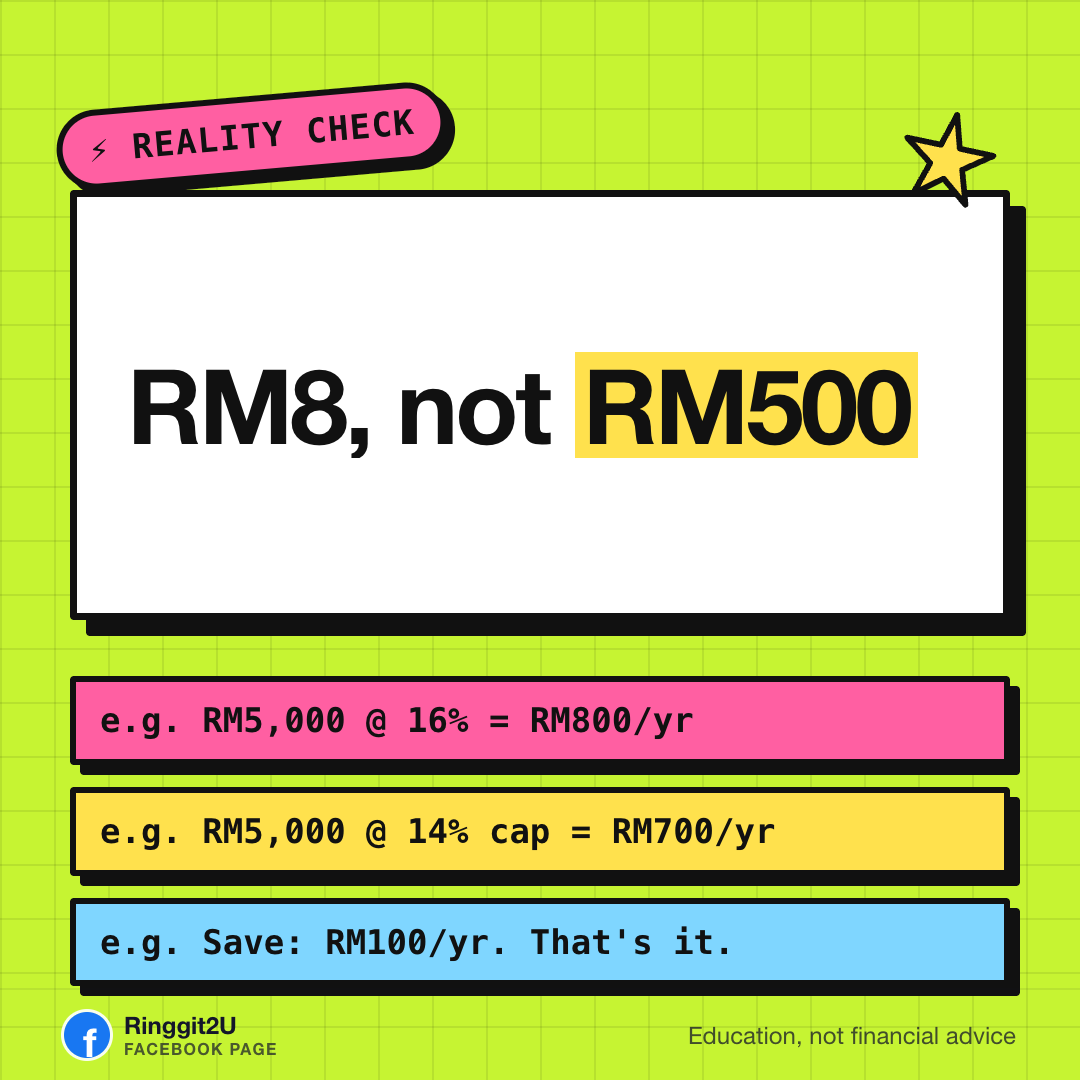
- e.g. On a RM5,000 balance the saving is about RM100 a year, roughly RM8 a month.
- The word 'basic' matters: premium or co-branded cards may sit in a different tier. Check your bank's terms page.
What Budget 2027 actually proposes
On 9 October 2026, Prime Minister Anwar Ibrahim tabled Budget 2027. One of the measures: basic credit card interest is capped at 14% per annum. That is the ceiling. Your bank cannot charge more than that on a card in the 'basic' tier.
This is a proposal. It takes effect only after the Finance Bill passes Parliament and the rule is gazetted. Until then, your current rate still applies.
The cap is a ceiling, not a floor. If your bank already charges 12% on a basic card, your rate stays at 12%. The rule only stops rates from going above 14%.
The word doing all the work: 'basic'
The cap applies to basic credit cards. Most banks run several tiers: a standard or 'basic' card, a gold or premium card, and co-branded cards tied to airlines or loyalty programmes. The 14% ceiling attaches to the basic tier.
Your card might not be in that tier. A co-branded travel card or a premium card with a higher annual fee often carries its own rate schedule. The cap may not touch it.
The confusion is real. A Lowyat forum thread tracking credit card debt strategies has crossed 14,069 replies and 1.8 million views, with new posts this week alone. Most of the questions repeat the same line: 'Does this apply to my card?'
The math: who saves what
The saving depends on two things: how much you owe and what your current rate is. The cap only matters if your rate is above 14%.
e.g. You carry RM5,000 on a basic card at 16% per annum, so interest for the year is RM800. At the 14% cap it is RM700. You save RM100 a year, about RM8 a month.
For example, the same RM5,000 at 18% gives you RM900 in interest. Capped at 14%, it is RM700. Saving: RM200 a year, roughly RM17 a month. The higher your starting rate, the bigger the gap.
For example, RM20,000 at 16% costs RM3,200 a year in interest; at 14% it costs RM2,800, saving RM400 a year, about RM33 a month. The percentage of each payment that goes to interest barely shifts, but the absolute ringgit is more visible.
What the cap does NOT do
The cap does not erase your balance. If you owe RM5,000, you still owe RM5,000. The rule only slows how fast that number grows while you pay it off.
It does not change your minimum payment. Your bank sets the minimum (usually a percentage of the outstanding balance plus any new charges). That requirement is unchanged.
It does not stop interest from accruing on the outstanding amount. You are still paying interest every month until the balance hits zero. The cap just sets the maximum rate at which that interest compounds.
What to check before you celebrate
Open your bank app or flip to the back of your last statement. Find the interest rate printed on your card. If it is already below 14%, the cap changes nothing for you.
Next, check which tier your card sits in. Most banks list their card tiers on their website under 'Terms and Conditions' or 'Product Features.' Look for the words 'basic,' 'standard,' 'premium,' or 'co-branded.'
If your rate is above 14% and your card is in the basic tier, the cap will help once it takes effect. If your card is in a higher tier, the saving may be smaller or zero. Ask your bank's customer service which category your card falls under.
Pros & cons
✅ Good for you
- Sets a hard ceiling so rates cannot drift higher on basic cards
- Reduces the cost of carrying a balance for anyone above 14%
- Gives a clear number to compare against when shopping for a card
⚠️ Watch out
- Applies only to the 'basic' tier; premium and co-branded cards may be excluded
- Does not reduce your outstanding balance or minimum payment
- Is a proposal until the Finance Bill passes; timing is not guaranteed
What you can do
- Find your card's current interest rate
Open your bank app or read the back of your last statement. The rate is usually printed as 'interest p.a.' or 'annual rate.' Write it down.
- Check which tier your card is in
Go to your bank's website and look under 'Terms and Conditions' or 'Product Features' for your specific card name. Note whether it is listed as basic, standard, premium, or co-branded.
- Compare your rate to the 14% cap
If your rate is already at or below 14%, the cap changes nothing for you. If it is above 14% and your card is in the basic tier, you will see a lower rate once the rule takes effect.
- Ask your bank for written confirmation
Call the number on the back of your card or use the in-app chat. Ask: 'Is my card in the basic tier covered by the 14% cap?' Keep the reference number.
- Re-check your balance-transfer options
Some banks offer promotional 0% balance-transfer periods. The cap is a long-term ceiling; a transfer offer can save you more in the short term. Compare both before deciding.
Questions people ask
Does the 14% cap mean my credit card rate will drop to 14%?
No. 14% is the maximum. If your bank already charges 12% on a basic card, your rate stays at 12%. The cap only stops rates from going above 14%.
Will the cap reduce the amount I owe?
No. You still owe your full outstanding balance. The cap only limits how fast interest adds to that balance while you pay it off.
My card is a co-branded travel card. Does the cap apply?
The Budget 2027 measure names 'basic' credit cards. Co-branded and premium cards often carry separate rate schedules. Check your bank's terms page or call customer service to confirm which tier your card is in.
When does the 14% cap actually start?
It is a proposal in Budget 2027, tabled on 9 October 2026. It takes effect after the Finance Bill passes Parliament and the rule is gazetted. The exact start date has not been announced yet.
I pay my full statement balance every month. Does this matter to me?
If you pay the full amount before the interest-free period ends, you typically do not accrue interest. The cap matters most to people who carry a balance month to month.
Keep reading
PTPTN Deferment: 400,000+ Borrowers Under RM2,500 Get a Pause
Budget 2027 proposes PTPTN repayment deferral for 400,000+ borrowers earning under RM2,500. What defer means, what it does not, and how to check your eligibility.
EPF Auto-Registration at 18: What Budget 2027 Changes
Budget 2027 proposes automatic EPF registration for every Malaysian at 18. Learn what it means for your first salary, your three KWSP accounts, and how to check.
Budget 2027: RM2,000 Minimum Wage, RM2,500 Starting Wage – Your Real Take-Home
Budget 2027 raises the minimum wage to RM2,000 and proposes a RM2,500 starting wage for graduates. Here is your actual take-home after EPF, SOCSO and EIS deductions.