Legasi study: Bumiputera median EPF savings four times below Chinese members
An independent Legasi study published in October 2026 shows the EPF savings gap between Bumiputera and Chinese members widened after pandemic withdrawals, even though the wage gap between the two groups stayed narrower.
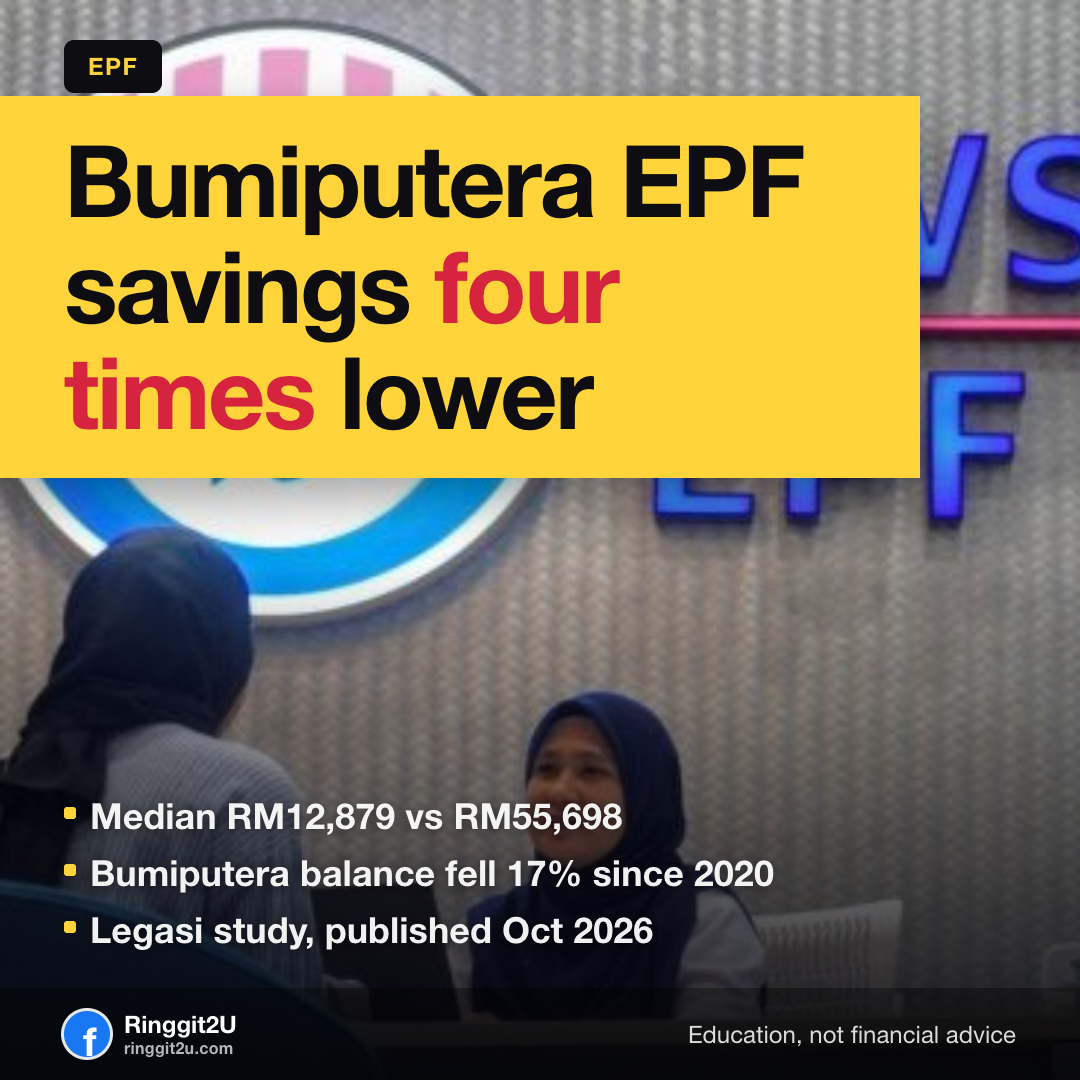
What happened1/6 Legasi finds a four-fold EPF savings gap between Bumiputera and Chinese members
Independent research body Legasi published a report titled Jurang Kekayaan Antara Etnik di Malaysia (Siri 1) in October 2026. It compared median EPF savings for members under 55 across three ethnic groups.
The headline finding: Bumiputera members held a median EPF balance of RM12,879 in 2025. Chinese members held RM55,698. That is a ratio of roughly 0.23 to 1, meaning Bumiputera median savings sit at about one-quarter of Chinese median savings.
Indian members sat in between at RM22,028. Legasi said the gap is more concerning because Bumiputera EPF savings have not recovered from the pandemic-era special withdrawals of 2020 and 2021.
The real numbers2/6 Pandemic withdrawals pushed Bumiputera EPF savings down 17%, Chinese savings up 22%
RM12,879Bumiputera median EPF, under 55, 2025RM55,698Chinese median EPF, under 55, 2025RM22,028Indian median EPF, under 55, 2025Legasi compared April 2020 (just before the pandemic withdrawals) with 2025. Bumiputera median EPF savings fell 17%, from RM15,500 to RM12,879. Chinese median savings rose about 22%, from RM45,800 to RM55,698. Indian median savings dropped 14%, from RM25,700 to RM22,028.
The study notes that Bumiputera median EPF savings have not recovered from the 2020-2021 special withdrawals and have continued to fall below pre-pandemic levels.
Group April 2020 2025 Change Bumiputera RM15,500 RM12,879 -17% Chinese RM45,800 RM55,698 +22% Indian RM25,700 RM22,028 -14% Median EPF savings, members under 55 (April 2020 vs 2025)
- 01/03
RM12,879 Bumiputera median EPF, under 55, 2025 Pandemic withdrawals pushed Bumiputera EPF savings down 17%, Chinese savings up 22% Bumiputera median EPF, under 55, 2025
Why it matters3/6 The wealth gap is wider than the wage gap: asset income is the bigger divide
Legasi noted that the income and wage differences between Bumiputera and Chinese earners are more contained than the EPF savings gap. In 2024, median monthly household income was RM6,559 for Bumiputera versus RM8,886 for Chinese, a ratio of 0.74 to 1. In 2025, median wages were RM2,688 versus RM3,324, a ratio of 0.81 to 1.
The bigger divide sits in income from property and investments. Bumiputera households earned a median RM851 a month from assets in 2024, against RM1,629 for Chinese households, a ratio of 0.52 to 1. That gap actually widened from 0.54 to 1 in 2014, even though both groups saw income rise over the decade.
Legasi's point: the wealth gap is wider than the wage gap because income from property and investments (0.52 to 1) is more unequal than wages (0.81 to 1). The report argues that policy should look beyond income and also address access to asset ownership and long-term wealth-building.
How it works4/6 How EPF contributions work: 11% from you, 12-13% from your employer
Every month, your employer deducts 11% of your wages for your EPF employee contribution. The employer adds a separate contribution on top: 13% for wages up to RM5,000, and 12% for wages above RM5,000. The employer share never comes out of your take-home pay.
Since 11 May 2024, new contributions are split into three accounts: 75% goes to Akaun Persaraan (locked until 55), 15% to Akaun Sejahtera (housing, education, health and other approved purposes), and 10% to Akaun Fleksibel (withdraw any time, subject to a minimum balance). You cannot top up Akaun Fleksibel yourself.
Because EPF savings are a percentage of wages, a lower median wage means a smaller monthly EPF credit, and the gap compounds over a 30- or 35-year career.
- 02/03
Pandemic withdrawals pushed Bumiputera EPF savings down 17%, Chinese savings up 22% ✓Chinese median EPF, under 55, 2025 RM55,698 Chinese median EPF, under 55, 2025
How it affects your wallet5/6 At the median wages in the study, here is what actually lands in EPF each month
Legasi reported median wages of RM2,688 (Bumiputera) and RM3,324 (Chinese) in 2025. Using Ringgit2U's payroll calculator at YA2026 rates for a single resident under 60 with automatic reliefs only:
e.g. At a gross of RM2,688, the employee EPF deduction is RM296 a month. SOCSO is RM13.25, EIS is RM5.30, and PCB is RM0 because no income tax is owed at this level. Take-home is about RM2,373. The employer adds RM350 on top into EPF.
e.g. At a gross of RM3,324, the employee EPF deduction is RM366 a month. SOCSO is RM16.75, EIS is RM6.70, PCB is RM0. Take-home is about RM2,935. The employer adds RM433 on top.
e.g. Over 12 months, the employee-side EPF credit is about RM3,552 at the Bumiputera median wage versus RM4,392 at the Chinese median wage, before the employer share. The take-home gap between these two salaries is modest; the compounding EPF difference over a career is not.
Worth knowing6/6 Legasi says policy should target asset ownership, not just income
The report argues that Malaysia's socio-economic progress should not be measured only by narrowing income gaps. Legasi recommends that development policy place greater emphasis on building wealth and access to asset ownership in a targeted, transparent and fair way, so that the benefits of growth do not concentrate among a small elite.
The full report, Jurang Kekayaan Antara Etnik di Malaysia (Siri 1), was published by Legasi in October 2026.
- 03/03
Pandemic withdrawals pushed Bumiputera EPF savings down 17%, Chinese savings up 22% Monthly statement Bumiputera -17% Chinese +22% Indian -14% Median EPF savings, members under 55 (April 2020 vs 2025)
Questions people ask
What is the median EPF balance for Bumiputera members under 55?
RM12,879 in 2025, according to Legasi's October 2026 study. That is down 17% from RM15,500 in April 2020, before the pandemic-era special withdrawals.
Is the EPF savings gap only because Bumiputera earn less?
No. The wage gap is 0.81 to 1 (RM2,688 vs RM3,324), but the gap in income from property and investments is wider at 0.52 to 1 (RM851 vs RM1,629). The overall wealth divide is bigger than the wage divide alone.
Did the pandemic EPF withdrawals hit Bumiputera savings harder?
Legasi found Bumiputera median EPF savings fell 17% from April 2020 to 2025 and have not recovered from the 2020-2021 special withdrawals. Chinese median savings rose 22% over the same period.
How much goes into EPF from a RM2,688 salary?
The employee contributes 11%, which is RM296 a month. The employer adds 13% (RM350) on top. e.g. Together, RM646 goes into EPF monthly before any voluntary top-ups. Take-home is about RM2,373.
Source: KWSP (EPF)Dagang News
Keep reading

AI Selloff and Recession Fears: What It Means for Your EPF and Unit Trust
Reuters called October's AI selloff brutal as the Nasdaq-100 neared correction territory. Here is what the global move means for your EPF and unit trust.

Intel Crashes 29%: What a US Tech Selloff Means for Your EPF
Intel plunged 29% and the Nasdaq shed $2 trillion in October on AI fears. Here is what a US tech crash does and does not change for your EPF.
i-Emas at 55: How EPF Monthly Payouts Work, With the Maths
i-Emas lets EPF members take monthly payouts at 55 or 60 while the rest keeps earning dividends. The RM650,000 benchmark, the maths and how to plan in i-Akaun.