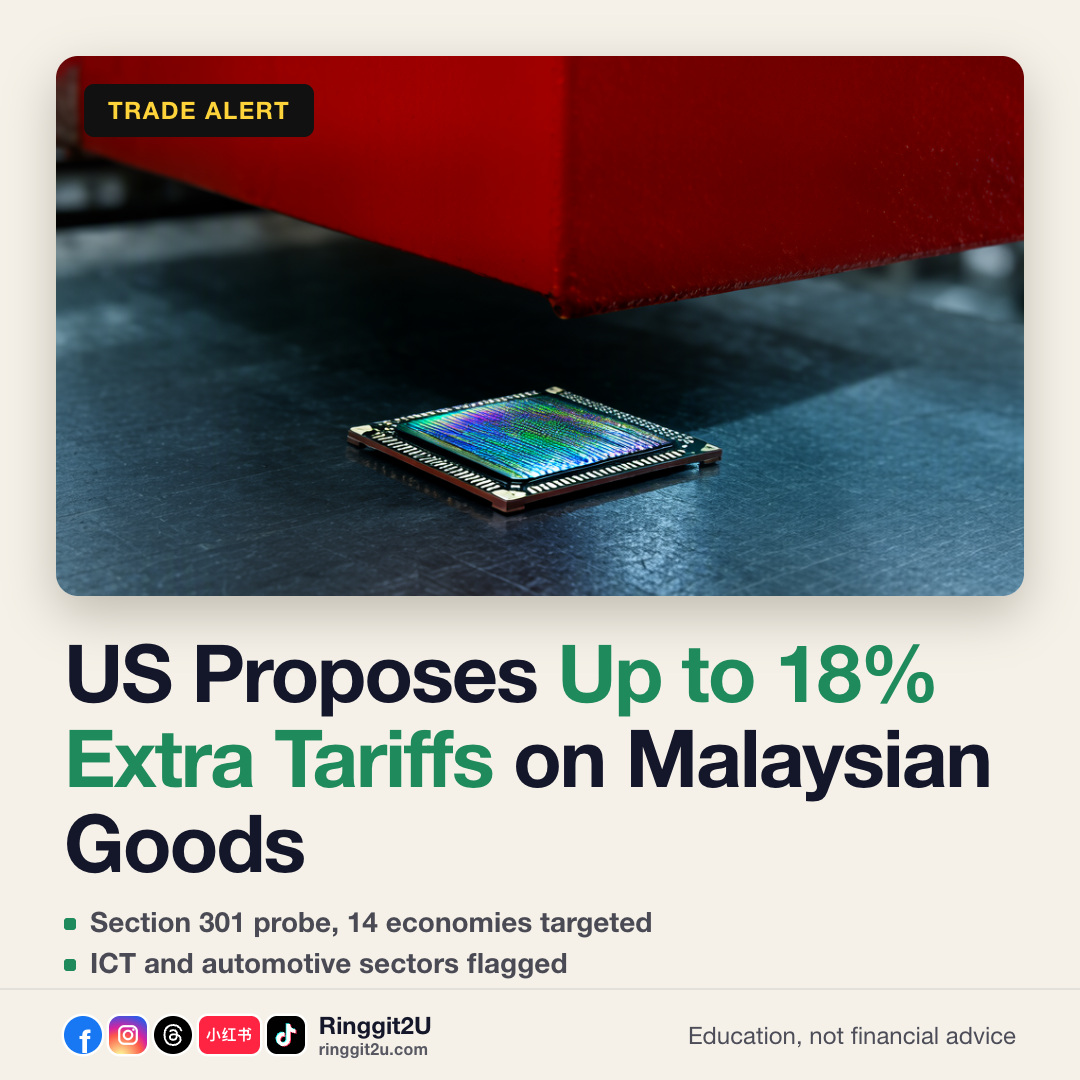
US Proposes Up to 18% Tariffs on Malaysian Goods Under Section 301
Washington proposed up to 18% extra tariffs on Malaysian goods under a Section 301 probe, flagging ICT and automotive sectors, though the rate is not yet law.
What happened1/6 US proposes 18% extra tariffs on Malaysian goods
The United States has proposed additional tariffs of up to 18 per cent on Malaysian goods after a Section 301 investigation found that Malaysia's industrial policies and manufacturing practices contribute to what Washington calls structural excess capacity. US Trade Representative Jamieson Greer announced the proposal on 25 November 2026, reported Bernama.
Malaysia is one of 14 economies facing proposed tariffs under Section 301 of the US Trade Act of 1974. Headline rates across those economies range from 15 to 35 per cent. The others include China, Singapore, Indonesia, Thailand, Vietnam, Japan and the European Union.
The tariffs would sit on top of existing duties where applicable, with exemptions for certain products. The rate is net of existing Section 301 tariffs, and the proposal also accounts for duties already imposed under Section 232.
The real numbers2/6 The key figures behind the proposal
18%proposed tariff ceiling on Malaysian goods14 economiesfacing Section 301 tariffs, rates 15-35%25%escalation rate if consultations failThe 18 per cent figure is a ceiling, not a flat rate on every Malaysian export. USTR said certain goods would be exempted, and the rate is calculated net of tariffs already in place under Sections 301 and 232.
USTR also flagged an escalation path: if ongoing consultations with Malaysia and commitments under the US-Malaysia Agreement on Reciprocal Trade are judged unsatisfactory, the proposed rate could rise to up to 25 per cent, again net of existing Section 301 tariffs.
The investigation into Malaysia was initiated on 11 March 2026, with bilateral consultations held on 12 May 2026. The proposal remains under consultation; no enactment date has been set.
Photo: Photo: CC0 via Openverse Why it matters3/6 What Section 301 targets and why Malaysia was named
Section 301 lets the US Trade Representative investigate whether a trading partner's policies burden or restrict US commerce, then propose retaliatory tariffs. The investigation into Malaysia was initiated on 11 March 2026, with bilateral consultations held on 12 May 2026.
USTR's findings against Malaysia centred on four areas: industrial and sectoral plans to expand manufacturing and exports, preferential financing through national funding programmes, insufficient action to address excess capacity linked to imports and foreign investments from non-market economies, and inadequate labour protections.
The report singled out information and communications technology (ICT) and the automotive industry as sectors of particular concern, arguing that these policies could reduce commercial opportunities for US producers and exporters in Malaysia and other markets.
Greer framed the action as addressing unfair trade practices and strengthening American manufacturing competitiveness, saying trading partners had for decades built industrial strategies on wage suppression, non-market inputs and other market-distorting practices.
Malaysia's government pushed back in the consultations, arguing it operates a rule-based, market-driven trade regime and that its exports are complementary to, not in competition with, US domestic production. USTR acknowledged that position in its report.
How it affects your wallet4/6 What this means for Malaysian workers and households
The direct consumer cost inside Malaysia is small: these are tariffs the US imposes on goods entering the US, not a tax Malaysians pay at the checkout. The real exposure is on the export side, particularly ICT manufacturing and automotive parts factories that ship to the American market.
If the tariffs are enacted and no exemptions cover a factory's product line, a US buyer facing an extra 18 per cent cost may shift orders to another supplier. That puts pressure on production volumes, overtime and hiring at those plants. e.g. a Penang-based semiconductor packaging firm or a Shah Alam auto-parts maker shipping to US OEMs would feel the squeeze first.
For now, the 18 per cent is a proposal under consultation, not an enacted law. No tariff has changed at the border yet. But the four findings and the two named sectors tell you exactly where the pressure will land if this proceeds.
- 01/01
18% proposed tariff ceiling on Malaysian goods The key figures behind the proposal proposed tariff ceiling on Malaysian goods
What to do, step by step5/6 What you can do today, depending on your role
If you work in ICT or automotive export manufacturing:
Ask your finance or HR team what share of your plant's revenue comes from US-bound shipments. That number tells you how exposed your overtime and shift schedule are. If a significant share of your plant's revenue depends on US-bound shipments, raise the question at your next town hall or union meeting.
If you run an SME that exports to the US:
Open your last 12 months of shipping documents and list every HS product code that goes to American buyers. Cross-check those codes against the proposed exemption list once it is made public. Track updates through MITI (miti.gov.my) and MATRADE (matrade.gov.my). Contact MITI (miti.gov.my) or MATRADE (matrade.gov.my) to register your concern and ask whether your product codes fall inside or outside the proposed coverage.
If you are a worker worried about job security in an exposed sector:
Check your employment contract for the notice period on changes to overtime or shifts. If your employer cuts overtime or shifts, confirm the change follows your contract terms. For retrenchment, PERKESO (perkeso.gov.my) runs the Employment Insurance System (EIS); know the claim window before you need it.
If you are a consumer or general reader:
Nothing changes at your checkout today. These tariffs hit goods leaving Malaysia for the US, not goods sold domestically. Keep an eye on whether any US buyer cancels a Malaysian factory contract, because that is the channel through which a trade dispute eventually touches a household budget.
Worth knowing6/6 Worth knowing
The escalation trigger is specific: USTR said it would consider raising the rate to 25 per cent only if it judges Malaysia's consultations and its commitments under the US-Malaysia Agreement on Reciprocal Trade to be unsatisfactory. That agreement is one of the factors USTR will weigh before escalating to 25 per cent. Malaysian exporters and their trade associations should push their industry positions through MITI into those consultations rather than waiting for a final US tariff announcement.
Questions people ask
Is the 18% tariff already in effect?
No. As of 26 November 2026, the 18 per cent rate is a proposal announced by USTR on 25 November. It has not been enacted into law and no tariff has changed at the US border. Ongoing consultations with Malaysia and the US-Malaysia Agreement on Reciprocal Trade are still in play.
Which Malaysian sectors are most exposed?
USTR's report specifically named information and communications technology (ICT) and the automotive industry as sectors of particular concern. Companies in those sectors that export to the US market face the most direct risk if the tariffs are enacted without exemptions.
What is Section 301 of the Trade Act of 1974?
It is a US law that lets the Trade Representative investigate whether a trading partner's policies burden or restrict US commerce. If violations are found, the US can propose retaliatory tariffs. The current action against 14 economies, including Malaysia, uses this mechanism.
Could the tariff go higher than 18%?
Yes. USTR stated that if ongoing consultations and commitments under the US-Malaysia Agreement on Reciprocal Trade are found unsatisfactory, it would consider raising the proposed rate to up to 25 per cent, net of existing Section 301 tariffs.
Source: Bernama