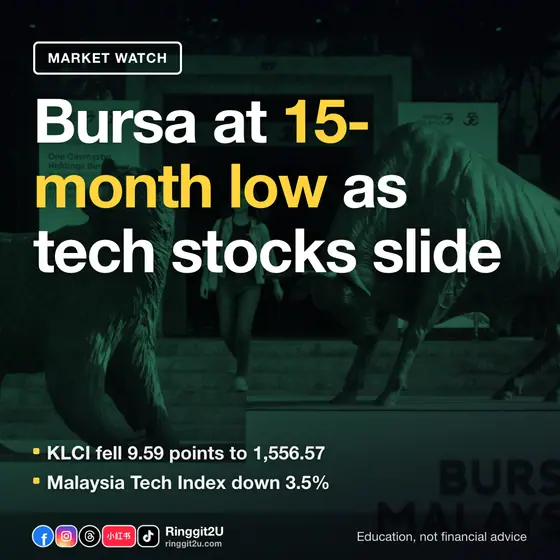
US Stocks Enter Correction as AI Panic Drags FBM KLCI to Sixth Straight Day of Losses
The S&P 500 and Dow entered correction territory after an AI-driven selloff, pulling the FBM KLCI down for a sixth straight day and hitting Malaysian tech stocks.

What happened1/5 US stocks fall over 10% from highs, entering correction territory
Last week, both the S&P 500 and the Dow Jones Industrial Average fell more than 10% from their recent highs, formally entering technical correction territory. The Nasdaq closed down more than 5% on Friday, erasing its entire 2026 gain.
The selloff was driven by doubts over AI infrastructure spending returns, a weak post-IPO showing from Anthropic, elevated inflation and a slower pace of central bank easing. Apex Securities called it Wall Street's worst week in over 18 months.
The panic spread across Asia on Monday, 23 November 2026. Japan's Nikkei dropped more than 5% to 3,007. South Korea's Kospi dropped 3% at the open and was later pummeled by nearly 4% to 4,683.
The real numbers2/5 The damage across markets, in real numbers
-10%+S&P 500 and Dow from recent highs1,547.90FBM KLCI Monday open, 6th day down-5%Nikkei to 3,007; Nasdaq erased 2026 gainThe FBM KLCI fell 8.61 points to 1,547.90 in the opening minutes of trade on Monday, extending the sell-off for a sixth straight day. Apex Securities flagged that holding above the 1,550 support level is the key near-term test for the index.
On the local tech index, MPI shaved 38 sen to RM33.38, Vitrox fell 28 sen to RM8.44, UWC dropped 17 sen to RM5.26 and Cnergenz shed 13.5 sen to 99.5 sen. Dnex slid 1.5 sen to 40.5 sen and JCY dropped four sen to 43.5 sen.
FBM KLCI Monday open, 6th day down 1,547.90 01/01The damage across markets, in real numbers FBM KLCI Monday open, 6th day down
Why it matters3/5 Why AI triggered this, and why the Fed may not rescue it
The trigger was a broad de-rating of AI and semiconductor-linked equities that started in the US and spread to Europe and Asia. Investors questioned whether the billions poured into AI infrastructure would actually generate returns. Anthropic's weak post-IPO performance added fuel.
As equities tumbled, traders cut bets on further Federal Reserve rate hikes. CME Group's FedWatch tool showed the probability of a 25-basis-point hike next month fell to about 95.2%, with a 4.8% chance of holding steady. A week earlier, the market had fully priced in the hike and even assigned over 10% odds to a 50-basis-point move.
Rate pricing now shows the market expects fewer than three more 25-basis-point hikes in this cycle. The next hike is fully priced in only for the January meeting, with possibly one more in March. Rate cuts are not expected until 2028.
Several economists pushed back on the idea that this selloff changes the Fed's path. Avery Shenfeld, chief economist at CIBC Capital Markets, said only a much larger pullback would materially dent the wealth created by stock gains over the past four years. Scott Anderson, chief US economist at BMO Capital Markets, agreed that people made a lot of money over those years and a modest decline would not hit household spending.
How it affects your wallet4/5 What this means for your Malaysian wallet
If you hold EPF savings, your retirement account is not directly affected by a single week of global selling. EPF's dividend depends on its entire portfolio and is decided once a year. There is no reason to touch Akaun Persaraan or Akaun Sejahtera because one index fell.
If you hold unit trusts or ETFs linked to US or Asian tech, your NAV will show the same percentage drops listed above. e.g. a RM1,000 unit trust holding tracking the Nasdaq would show roughly RM50 less on Friday's close, before any Monday rebound. The actual figure depends on the fund's holdings and currency exposure.
If you have no equity exposure at all, the direct hit to your bank savings or fixed deposit is zero. The indirect risk is a weaker ringgit or slower hiring if the selloff deepens, but that is not yet the case.
TA Securities noted that increasingly oversold conditions could spur bargain hunting as selected blue-chip heavyweights look attractive after the sell-off. That is a market observation, not a recommendation. Whether to act depends on your own risk tolerance and time horizon.
What to watch5/5 What to watch this week and the next
The FBM KLCI's 1,550 support level is the immediate line. If it breaks, Apex Securities expects further pressure. If it holds, the sixth-day losing streak may end.
The 3Q26 earnings season is ongoing. Results from Bursa-listed tech and semiconductor names will show whether the AI spending doubts have hit actual Malaysian revenue.
The KLCI's phased expansion from 30 to 50 constituents continues as a domestic catalyst, though Apex said it is likely overshadowed by the external AI-selloff narrative for now.
Wall Street futures on Monday pointed to a rebound: the Nasdaq mini bounced 2.7%, the S&P 500 mini gained 2.2% and the Dow mini rose 1.5%. A confirmed rebound would ease pressure on Asian markets including Bursa.
The next Fed meeting is the key global date. A 95.2% priced-in hike means a surprise hold would likely spark a relief rally; a hawkish surprise would deepen the selloff.
Questions people ask
Does a US stock correction affect my EPF savings?
Not directly. EPF invests across a diversified portfolio and declares dividends once a year. A one-week global selloff does not change your Akaun Persaraan balance. Check your actual savings in the KWSP i-Akaun app.
Should I sell my unit trusts or ETFs now?
That depends on your own financial situation, time horizon and risk tolerance. Ringgit2U does not give buy or sell advice. If you are unsure, speak to a licensed adviser registered with the Securities Commission at sc.com.my ↗, or consult AKPK at akpk.org.my ↗ for free financial counselling.
What does a 'correction' actually mean?
A correction is a decline of 10% or more from a recent high in a major index. It is a technical label, not a crash. A bear market is typically defined as a 20% fall. The S&P 500 and Dow crossed the 10% threshold last week, which is why headlines used the word.