Housing loan approvals drop to 38.36% as banks tighten scrutiny
JLL Malaysia says banks are becoming more selective on home loan applications over inflated SPA prices, cash-out schemes and service apartment risks, with approvals at 38.36%.
What happened1/6 Approval rate drops below the 40% mark for the first time since 2022
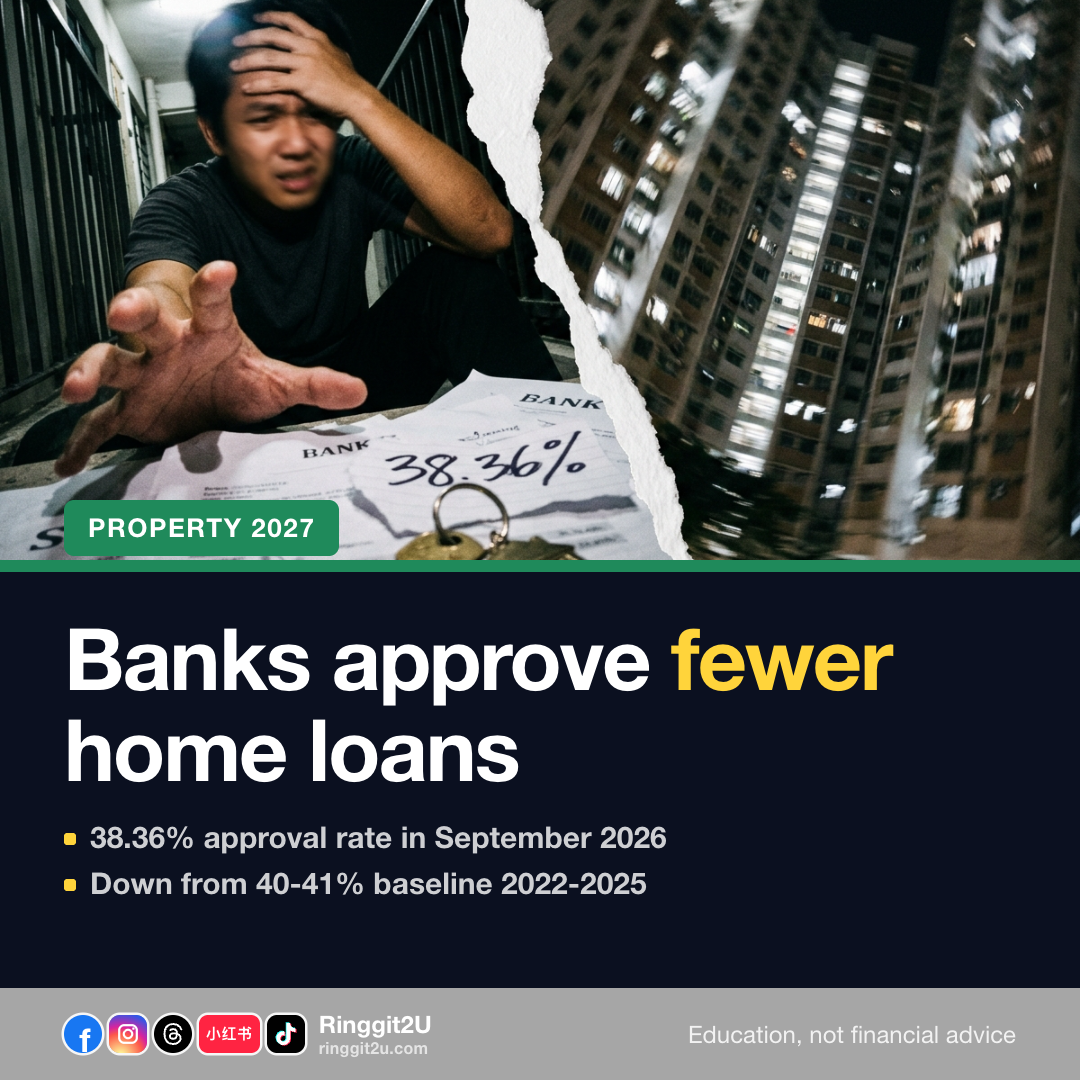
Housing loan approval rates in Malaysia fell to 38.36% in September 2026, down from the 40% to 41% range banks maintained between 2022 and 2025.
JLL Malaysia managing director Jamie Tan said the moderation comes from banks becoming more selective on income documentation, inflated sale and purchase agreement (SPA) prices, and service apartment vacancy risks. He spoke at JLL's property market briefing on 10 November 2026.
JLL expects the full-year 2026 approval figure to land below previous years as lenders tighten underwriting criteria.
The real numbers2/6 The numbers behind the tightening
38.36%Housing loan approval rate, Sep 202640–41%Approval baseline, 2022–202562%Residential share of real estate marketThe residential sector accounts for roughly 62% of Malaysia's overall real estate market. Jamie warned that failure to control overbuilding in this segment could trigger long-term market instability, as supply imbalances in other economies always started in housing.
Bank Negara Malaysia has held the OPR at 2.75% since its 3 September 2026 meeting, the seventh unchanged decision in a row. Jamie flagged the risk that any future OPR increase could further dampen housing demand, since most buyers rely on floating-rate home loans.
State Q2 2026 performance Kuala Lumpur Transactions up ~7% vs Q1; value nearly flat Pulau Pinang Lowest volume and value in 5 years Selangor Recovered from Q1 dip; weakest Q2 in 4 years 
How it works3/6 How a cash-out deal works and why banks are flagging it
A cash-out arrangement sets the SPA price above the property's assessed market value so the buyer can draw a larger loan and pocket the difference in cash.
JLL Malaysia executive director and head of retail valuations Jeannie Tan said panel valuers appointed by banks are actively flagging these price discrepancies. Valuers assess properties at much lower, more realistic levels than the inflated SPA price.
Jeannie noted that individuals without payslips sometimes inflate the purchase price to obtain higher financing. She stressed that the extra cash does not relieve the buyer of loan repayment obligations.
Why it matters4/6 Service apartments in KL are raising red flags for lenders
Jeannie pointed to high-density service apartments in the Kuala Lumpur City Centre, where many developments were built predominantly for foreign buyers. When expensive, premium-priced units target primarily foreign purchasers, high vacancy rates often follow.
When occupancy drops, owners frequently turn to short-term rentals like Airbnb, which remain largely unregulated in certain parts of KL. Banks treat heavy reliance on short-term rentals as a sign of weak long-term tenancy and stable occupancy.
Jamie said failure to control overbuilding in the residential segment could trigger long-term market instability, citing other economies where supply imbalances started in housing.
Housing loan approval rate, Sep 2026 38.36% 01/02The numbers behind the tightening Housing loan approval rate, Sep 2026
How it affects your wallet5/6 Self-employed and gig workers face the hardest squeeze
Jamie said self-employed individuals and gig-economy workers, even those with high incomes, struggle to get conventional financing because they cannot produce a payslip or proof of fixed salary.
He pointed to government-backed schemes like the Skim Jaminan Kredit Perumahan (SJKP) as a potential alternative for those who find it difficult to secure a conventional housing loan. Check the official channel for current eligibility and application steps.
The state-level data also hints at a shift: in KL, transaction volume rose about 7% from Q1 to Q2 2026 while transaction value stayed nearly flat, suggesting demand moved toward more affordable properties.
What to watch6/6 What to watch into 2027
JLL expects the residential market to face more pressure in 2027 as approval rates stay muted and supply imbalances build in certain areas.
Small and medium developers have already paused or postponed project launches while assessing market conditions ahead of 2027, Jamie said.
The OPR sits at 2.75% after seven consecutive unchanged Bank Negara decisions. Any move would flow through to floating-rate home loans via banks' base rates; fixed-rate loans are unaffected.
- 02/02
40–41% Approval baseline, 2022–2025 The numbers behind the tightening Approval baseline, 2022–2025
Questions people ask
What is a cash-out arrangement in a property purchase?
The buyer and seller agree on an SPA price higher than the property's true market value. The bank lends against the inflated price, and the buyer receives the difference in cash. JLL says panel valuers are now flagging these discrepancies, and banks are becoming very cautious when dealing with cash-out buyers.
Can a self-employed person still get a housing loan in Malaysia?
It is harder because conventional lenders typically require a payslip or proof of fixed monthly income. JLL highlighted this as a persistent challenge. Government-backed options like SJKP may help, but eligibility and terms should be checked through the official channel.
Will the OPR affect my home loan instalment?
The OPR is currently 2.75%, unchanged since the 3 September 2026 Bank Negara meeting. A future change would affect floating-rate home loans through banks' base rates. Fixed-rate loans, such as most car hire-purchase agreements, are not affected.
Source: LHDNThe Edge MalaysiaThe Star